METHODOLOGY
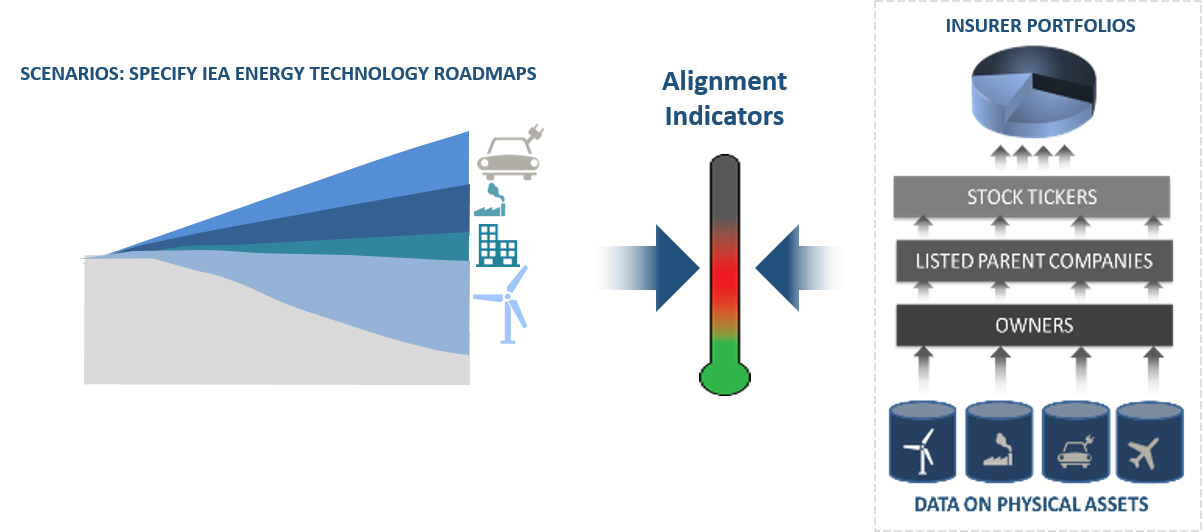
The objective of the assessment framework applied in this scenario analysis is to measure the alignment of investment portfolios with decarbonization pathways. The model consists of 3 key elements:
- Scenarios form the basis of the analysis and define the target against which portfolio trends are compared. While in theory a range of scenarios can be applied for the model, in the interest of simplification, this analysis will rely on the 1.75°C, 2°C, 2.7°C, and 3.2°C scenarios of the International Energy Agency (IEA). These provide targets for each technology at a regional level.
- Investment portfolios and associated financial data to allow for the portfolio assessment. The assets included in this report are corporate bonds plus the bonds of the largest government and municipal obligors, as well as the universe of public listed equities (source: Bloomberg). Funds held within the portfolios are decomposed into their constituent holdings and included as part of the portfolio (source: Morningstar).
- Physical / industry ‘asset level data’ (current and forward looking) is mapped to companies, parents, and securities. This allows the link between investment portfolios and industry and production data (oil and gas production, automotive production, and utilities) to be established. Further, this allows for a comparison to the 2°C scenarios and a corresponding evaluation of the alignment of the investment portfolios.
This methodology and modeling approach was developed as part of a multi-stakeholder research project with support from the European Union. It has been used by several hundred financial institutions and multiple supervisory authorities in Europe.
DATA
Insurer Investments
The insurer data used is from the 2017 year-end financial filings of all insurers operating in California with over $100 million in annual premiums, yielding a sample of over $4 trillion total holdings, the bulk of which is held in debt portfolios.
Asset Level Data
The Asset Level data is sourced from the following data providers:
- GlobalData (Power plant data, including plants classified as active, announced, financed, partially active, permitting, temporarily shutdown, under construction, under rehabilitation and modernization, and Oil and Gas production data and forecast until 2018 to 2023, as well as coal mining data);
- WardsAuto (light passenger duty vehicle, including BAU production forecasts for 2018 to 2023);
- Bloomberg (financial data);
- S&P Cross-Reference Services (database matching securities to parents);
- Morningstar (decomposition of funds).